In spite of the current farreaching tests, to which a medicine must be subjected before authorization, exceptionally risks may only be identified after the market launch when the product is in widespread application and everyday use. The cataloguing of spontaneous reports is still the best way to discover such problems early on.
You will find here all information about reporting the undesirable side-effects of medicines.
The need for pharmacovigilance
Medicines are developed over a period of several years. Efficacy and safety of a new drug are generally studied on a few thousand carefully selected and followed up trial subjects and patients according to strictly defined criteria. For this reason only very frequent adverse reactions and mainly those depending on the drug's pharmacological properties can be observed during its clinicaldevelopment.
Once the product has been placed on the market, a much larger, and also often polymorbid population will be exposed, which may lead to a change in the drug's hitherto known safety profile. Adverse drug reactions can then be observed more frequently, including those occurring only sporadically and independently of the pharmacological properties of the substance. These new adverse reactions, should be reported without delay as a contribution to a potentially still incomplete safety profile. If such information is consistently forwarded to the competent authorities hitherto unknown risks can be identified and tackled.

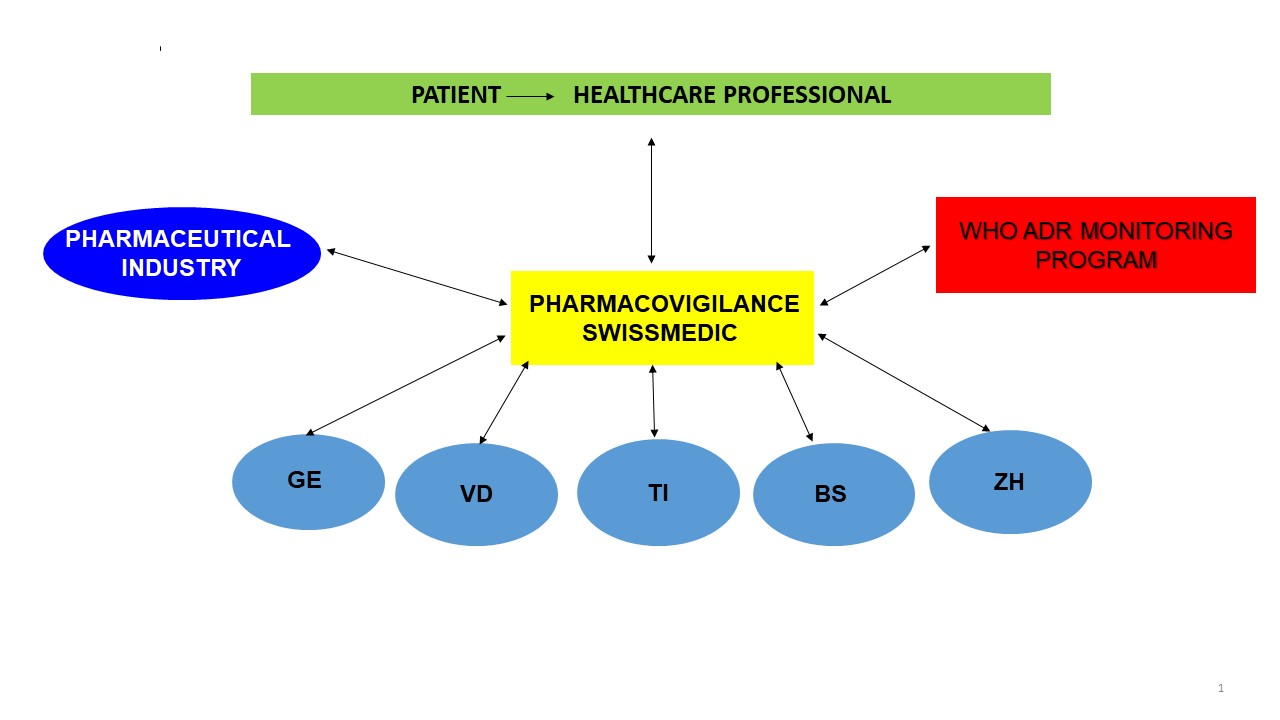
Reports of adverse reactions from professionals and consumers are sent to the six regional centres shown in red . The centres process the reports and forward them to Swissmedic's national pharmacovigilance centre. The pharmaceutical industry files adverse reactions reports received directly with Swissmedic. The national pharmacovigilance centre collaborates with the international centre for drug safety run by the World Health Organization.
Each of the regional centres is affiliated to an academic unit of clinical pharmacology and can also be consulted for therapeutic advice on pharmacotherapy.
The centres' addresses and telephone numbers are listed in the ElViS (Electronic Vigilance System) online reporting portal and on the back of the yellow reporting form.
In accordance with the new Law on Therapeutic Products implemented on 1 January 2019, all serious adverse reactions, hitherto unknown or insufficiently documented in the product information leaflet of the medicine concerned, as well as any other medically significant adverse reaction, must be reported.
Adverse reactions are considered serious if they:
- result in death;
- are life-threatening;
- lead to hospitalization or if they prolonge hospitalization;
- involve a persistent disability or incapacity ;
- are otherwise to be considered medically significant (if, for example, a timely medical intervention prevented one of the above-mentioned outcomes).
These suspected adverse reactions should be reported within 15 days of diagnosis; non-serious reactions should be reported within 60 days.
A causality between a reaction and a medicine need not be proved: suspicion alone is sufficient to justify reporting such events.
Although misuse, dependency and addiction are not covered by the WHO definition of an adverse drug reaction, as they do not relate to normal posology, it is important to report such events as they might affect the safety profile of a drug.
Under the Law on Therapeutic Products all professionals who are entitled to distribute, administer or prescribe medicines are subject to the obligation of reporting suspected adverse reactions to drugs. Pharmaceutical companies that manufacture or distribute ready-to-use medicinal products are also subject to a reporting obligation.
However, consumers may also report undesirable side-effects to drug therapy. A consultation with the family doctor leading to a joint report, has the advantage of providing relevant medical details such as results of investigations butis not compulsory.
Healthcare professionals
Adverse drug reactions should preferably be reported electronically using the online ElViS (Electronic Vigilance System) portal.
When filling in the data entry screens or form, please pay particular attention to the following points:
- The description of the adverse reactions with their symptoms and findings should be as precise as possible .
- The temporal relationship between the administration of the medicine and the onset of the reaction should be highlighted.
- The outcome, whether or not the symptoms resovled or improved after stopping the therapy should be reported.
- Details of all medicines administered, including start and end date of therapy should be given.
- Details of the differential diagnosis and not drug-related factors that may influence the clinical picture should be listed. In the case of liver damage for example, , alcohol consumption, biliary tract pathology, virus serology, etc. should be mentioned.
- When reporting reactions concerning vaccines, blood products or suspected quality issues, providing the lot number has been proved very useful.
Reports should then be sent direct to a regional pharmacovigilance centre.
Reports sent direct to Swissmedic are forwarded to one of the regional centres for processing.
Pharmaceutical industry
Pharmaceutical companies should preferably report adverse drug reactions to Swissmedic electronically via the gateway or using the online ElViS (Electronic Vigilance System) portal.
Alternatively the “Backingform spontaneous ADR reports from MAH (DOC, 159 kB, 02.03.2018)”, including CIOMS form, can be used.
Reports from healthcare professionals are evaluated in the regional centres. The primary reporter receives a brief written evaluation within seven days of submission.
Once evaluated the report is forwarded to Swissmedic's national centre for pharmacovigilance. The national centre carries out a final validation and evaluation of the report before it is completely anonymized and entered into the national database. If reports are incomplete it might be necessary to get back to the primary reporter via the regional centre. The pharmaceutical industry should forward any reports it receives direct to Swissmedic.
Swissmedic forwards all reports to the international centre for drug safety at the World Health Organization as it is an active member of the Programme for International Drug Monitoring.
The Swissmedic pharmacovigilance team carefully screens all incoming reports for new risks. If a new risk is identified, the need for action is evaluated and appropriate measures are taken in collaboration with the Swissmedic department responsible for the drug concerned.