The CHRN is issued to Swiss manufacturers, authorised representatives and importers, as well as to persons who assemble systems and procedure packs (according to Art. 55 MedDO and Art. 48 IvDO). The foreign manufacturer is not required to register in Switzerland as well but must appoint an authorised representative.
The authorised representative and importer must register with Swissmedic pursuant to Art. 55 para. 1 MedDO / Art. 48 para. 1 IvDO.
As a result of the revision of the applicable legislation for medical devices and in vitro diagnostic medical devices on 18 October 2022, economic operators based in Liechtenstein must now also register with Swissmedic.
If your company requires a CHRN for more than one role, separate applications have to be submitted for these. It is not possible to issue a single CHRN for several roles.
A CHRN is required to register as an economic operator in Switzerland and place devices on the Swiss market (pursuant to Art. 55 MedDO and Art. 48 IvDO). Upon verification of the information provided by the economic operator, Swissmedic issues the CHRN via swissdamed.
The SRN issued via EUDAMED by a competent authority of an EU Member State does not replace the CHRN.
In principle, Swissmedic has a maximum of 30 days to process these applications. However, all applications are processed promptly, so if the volume of applications is low, the processing time may be shorter.
In the case of objections, the original submission date is no longer relevant. The 30-day period starts once all shortcomings have been rectified and Swissmedic is in possession of the required documentation.
Incoming applications are checked in terms of their content, and the required evidence to substantiate the facts is formally checked for correctness.
If documents or information are missing from an application, or they are invalid of incorrect, the application will be contested. If the requested adjustments/documents are not submitted within 30 days of the objection, the application will be rejected.
Log in with your AGOV-Login. Go to the “Company registration” tab and click on the “Register new company” button in the top right corner. Search for your company and confirm the company details. A letter with the validation code will be sent to the company’s address. After entering the validation code, your company is registered.
Contact the swissdamed support team via Support (swissmedic.ch) and provide the following information: company name, first name, last name, and email address of the person who will act as company admin. A commercial register extract is also required – or a residential address registration document if the applicant is a natural person.
If your company was registered via Zefix, the details of your company are synchronised automatically with Zefix. Therefore, the data in Zefix first has to be updated before the new data can be viewed in swissdamed.
If your company was registered manually, or if you have declined the automatic synchronisation with Zefix, you can modify the company details under “My actors” in the “Registered companies” tab by clicking on the pencil icon. For changes regarding the company name, please contact the swissdamed support team via Support (swissmedic.ch).
If your company is registered and validated, the company is shown under “My actors” in the “Registered companies” tab. Click on the “+” button next to the company to create a new actor request.
Under “My actors” in the “Registered actors” tab. The data for the highlighted actors has to be validated. To do so, open and check your actor registration request details (pencil icon on the right below “Actions”) and update and validate the data if necessary.
Under “My actors” in the “Registered actors” tab, open the actor registration details (pencil icon on the right below “Actions”) and make the desired changes.
This means either that your actor's data was automatically changed by the system by synchronisation with Zefix, or that your actor has not been updated for 365 days or 720 days. You must therefore make sure that your actor's data is up to date and confirm accordingly.
As actor admin, open the detail view for a registered actor and click on the “Inactivate actor” button at the top right of the mandate. In the pop-up, confirm that the actor will be inactivated and cannot be reactivated.
Following a review by Swissmedic, the reactivation can be carried out subject to a fee. The registration of an economic operator can be reactivated if the linked UID entry for the company in Zefix has the status "active" or "in liquidation".
Once the economic operator (CHRN) has been reactivated, its status changes to "Action needed". The CHRN data for the actor must therefore be validated and confirmed within 30 days.
According to Art. 4 Para. 2 of FeeO-Swissmedic (SR 812.214.5) fees will be charged on a time and material basis and invoiced separately if the registration of an economic operator is reactivated.
In order to register a new mandate, you need to be logged-in as actor admin. In “Registered actors” choose the authorised representative (AR) for whom you want to register a mandate. Open the actor and go to the mandate tab (or click on the “Go to mandates” on the right of the AR in the “Registered actors” overview). Click on the “Register a new mandate” button.
Choose the authorised representative (AR) for whom you want to update a mandate in “Registered actors”. Open the actor details and then open the mandate you want to update (pencil icon on the right below “Actions”).
As mandate admin, open the detail view for a registered mandate and click on the “Inactivate mandate” button at the top right of the mandate. In the pop-up, confirm that the mandate will be inactivated and cannot be reactivated.
The status “Not valid” indicates that the mandate is outside its validity period as defined by the fields “Mandate valid from” and “Mandate valid until”.
This information is visible:
in the mandate details;
in the details of the UDIs associated with the mandate;
in the public UDI/device search results.
When a mandate becomes not valid, an email is automatically sent to the authorised representative informing them that the mandate has expired and explaining the actions that need to be taken. Without a valid mandate, no devices may be placed on the Swiss market in accordance with Art. 51 MedDO.
If the mandate has expired (the “Mandate valid until” date is in the past), the current authorised representative must update the validity of the mandate, or the mandate must be inactivated or transferred to another authorised representative.
If the validity is not updated within the specified deadline, Swissmedic may take legal measures in the context of an administrative procedure. This includes, in particular, the inactivation of the mandate, which results in the linked UDI-DIs being assigned the market status “No longer placed on the market”.
If the validity of the mandate is extended or corrected so that the current date once again falls within the defined validity period, the mandate status is automatically reset to “Registered” and the invalidity indication is removed.
The mandates already reported were not imported into swissdamed due to a partial lack of data quality and different data information. Therefore, already reported mandates and new mandates must be entered in swissdamed.
In connection with the «Devices» module, so-called «Regulation Devices» (MDR and IVDR) can be uploaded as an XML file in EUDAMED format on a voluntary basis from 2025. However, in preparation for this, it is advisable to include the mandates in swissdamed as soon as possible, as the products will be directly linked to the mandates afterwards.
If you are a company admin and would like to authorize a foreign manufacturer to upload devices to a specific mandate, you need to grant that user the role "UDI Editor." This role can be granted as follows:
Onboard the user to the company as "company viewer".
The user will initially have the user role "none" at the actor level. This must be changed to "actor viewer."
After that step, the user will have the user role "none" at the mandate level. This must be changed to "mandate viewer" and "UDI Editor."
Now the user can upload devices and set the market status, but cannot edit company, actor, or mandate data. It is important to note that the user role "UDI Editor" cannot be assigned on the authorised representative level.
Additional information can be found in the User Guide Actors on the Support swissdamed website.
The company admin can invite new users to the company by clicking the respective action button on the company overview page. This will open a view where the admin has to enter the personal data and the company role (admin or viewer) to be assigned to the user.
You have to be logged in as company admin. In the “Company registration” tab, click on the pencil icon in the “Action” column on the right of the company to access the “Manage users” tab.
There is an action button at the end of the row that opens a pop-up window with the name and e-mail address of the selected user and the new role that can be assigned (admin if currently a viewer, or viewer if currently an admin).
If an error page appears when logging in, click again on the "Login" button at the top right of the menu.
If the problem persists, delete your browser history, close the internet tab and reopen swissdamed or contact the swissdamed support team via Support (swissmedic.ch)
If you have a registered company in swissdamed as well as an account for the eGov portal, and receive an error message when logging into swissdamed, please open an IT ticket (via Support). Make sure to mention in the ticket that you have both a swissdamed account and an account for the eGov portal (MLP / eMessage account), as this information will help our IT-team to resolve your issue more quickly.
ZUGLOGIN and #edaLogin can no longer be used to log into swissdamed. Please use your AGOV account instead. If you do not yet have an AGOV account, you can find further information at www.agov.admin.ch.
The UDIs of "old devices" do not have to be registered in swissdamed. However, even for "old devices" serious incidents, field safety corrective action or trends (vigilance) shall be reported to Swissmedic.
For certain medical devices the notification requirement will be replaced by the registration requirement in swissdamed, for a number of devices the notification requirement will continue to be applicable.
The notification requirement of devices will be replaced by the registration requirement in Swissdamed as follows:
1. For the following medical devices, the registration requirement of devices in swissdamed replaces the notification requirement as of 1 July 2026 (in accordance with Art. 108 MedDO and Art. 17 para. 5 MedDO which will enter into force on 1 July 2026):
MD-DEVIT products. This includes the following:
According to Art. 1, para. 3 letter c number 2 MedDO: products manufactured from derivatives of tissue or cells of human origin that are not viable or that have been killed off.
According to Art. 1 para. 3 letter d MedDO: products which contain non-viable tissue or non-viable cells of human origin, or the derivatives of such tissue or cells, as an integral constituent part at the time the products are placed on the market or put into service and where such tissue, cells or derivatives assume a supporting function in such products.
Class I medical devices according to art. 108 para. 1 letter a MedDO. These are class I medical devices according to the Regulation (EU) 2017/745 (MDR) and class I medical devices according to the Directive 93/42/EEC, that fall under the classes Ir, IIa, IIb or III according to MDR.
Systems and procedure packs being notified according to art. 108 MedDO.
2. For the following in vitro diagnosticmedical devices, the registration requirement of devices in swissdamed replaces the notification requirement as of 1 July 2026 (in accordance with Art. 90 IvDO and Art. 16 para. 5 IvDO which will enter into force on 1 July 2026):
In vitro diagnostic medical devices being notified according to Art. 90 para. 5 IvDO
For the following medical devices and in vitro diagnostic medical devices, the notification requirement remains in force after 1 July 2026:
Repackaged or relabelled medical devices according to Art. 53 or 54 MedDO.
Repackaged or relabelled in vitro diagnostic medical devices according to Art. 46 para. 4 or Art. 54 para. 4 IvDO in conjunction with Art. 16 para. 3 and 4 EU-IVDR.
Medical devices manufactured and used in health institutions according to art. 18 MedDO.
In vitro diagnostic medical devices manufactured and used in health institutions according to Art. 10 IvDO.
Custom-made devices according to Art. 19 MedDO
DEVIT products according to Art. 2a para. 2 TPA (notification according to Art. 103 para. 2 MedDO). These include:
All products made from devitalised human tissue or cells, with theexception of derivatives of such tissue or cells
Products which contain non-viable tissue or non-viable cells of human origin, or the derivatives of such tissue or cells, as an integral constituent part at the time the products are placed on the market or put into service and where such tissue, cells or derivatives assume a primary function in such products.
In swissdamed, a 1:1 relationship between Basic UDI-DI and UDI-DI is required for manual XML uploads.
A maximum of 300 Basic UDI-DI / UDI-DI pairs can be uploaded in the same XML file.
The following types for XMLs can be uploaded in swissdamed:
“Device GET”-XMLs downloaded from EUDAMED
“Device POST”-XMLs
The 1:1 ratio is applicable in swissdmed for Machine-to-Machine transactions, as described in the Machine-to-Machine specification.
The data has to be uploaded into swissdamed by the relevant economic operators. An interface between swissdamed and EUDAMED does not exist at this time. Therefore, Swissmedic cannot transfer or synchronize any data from EUDAMED.
Systems and procedure packs which are treated as devices in their own right according to Art. 11 para. 3 MedDO and Art. 22 para. 4 EU MDR, and for which the obligations of manufacturers according to Art. 46 – 50 MEdDO apply, must be registered using the actor type “Manufacturer (MF)” or via their mandate.
Unlike other systems and procedure packs, those SPPs that are treated as devices in their own right, cannot be registered using the actor type “Person who assembles systems or procedure packs(PR)”.
Yes. When registering a device in swissdamed which has electronic instructions for use, it is mandatory to provide the URL where the eIFU can be found.
Switzerland has adopted the requirements contained in the EU Commission Implementing Regulation (EU) 2025/1234, amending Implementing Regulation (EU) 2021/2226 as regards the medical devices for which the instructions for use may be provided in electronic form. These EU Commission Implementing Regulations apply directly in Switzerland, without additional amendments to MedDO.
Contact lenses, standard contact lenses and made-to-order contact lenses must be registered in swissdamed with the Master UDI-DI starting 9 November 2026.
Spectacle frames, spectacle lenses and ready-to-wear reading spectacles must be registered in swissdamed with the Master UDI-DI starting 1 November 2028.
Devices that require a Master UDI-DI can be uploaded to swissdamed by Swiss manufacturers (MF), authorised representatives (AR) and foreign manufacturers with a mandate (MT). A UDI Editor role is required for uploading.
All data included in the Data Dictionary are stored in swissdamed, even if some of the data are not displayed, except for the following EUDAMED XSD elements:
Entries in languages other than DE/IT/FR/EN/ANY/<without language>
No, swissdamed deletes XML files immediately after they have been successfully uploaded. XML files that cannot be successfully uploaded or that cause an error message will be automatically deleted after 14 days.
The UDI Devices Module has been available since August 2025. Since then, devices, systems and procedure packs can be registered on a voluntary basis. This includes devices under the current legislation (MedDO and IvDO) or the former legislation ("legacy" devices according to Art. 101 MedDO and Art. 82 IvDO).
As of 1 July 2026, both devices and systems/procedure packs placed on the market in Switzerland will have to be registered. The registration must be completed by 31 December 2026 at the latest (end of transitional period).
Immediate registration without a transitional period will become mandatory from 1 July 2026 for devices and systems and procedure packs for which a serious incident, field safety corrective action or trend must be reported to Swissmedic (Vigilance).
Swiss manufacturers of devices and IVDs (including manufacturers of systems and procedure packs) as well as the authorised representatives of foreign manufacturers can register UDIs in swissdamed provided they are registered as actors in swissdamed.
The registration obligation applies to devices under the current legislation (MedDO, including groups of products without an intended medical purpose listed in Annex 1 MedDO, IvDO), and to ("legacy") devices under the former legislation according to Art. 101 MedDO and Art. 82 IvDO, further sales units of which are placed on the market at the time the registration obligation enters into force on 1 July 2026.
Devices, systems or procedure packs that are placed on the market after the entry into force of the registration obligation on 1 July 2026:
must be registered before they are placed on the market
however, the registration must be completed by 31 December 2026 (transitional period).
If a product has already been registered in swissdamed in accordance with the applicable law, the corresponding legacy device must only be registered additionally if a serious incident or field safety corrective action (FSCA) exists for the legacy device, but not for the product registered under the applicable law.
Yes, devices, systems and procedure packs that were placed on the market before the entry into force of the registration obligation on 1 July 2026, and further sales units of which are placed on the market after 1 July 2026, must be registered in swissdamed by 31 December 2026
Medical devices are registered in swissdamed according to the provisions of Art. 17 para. 5 MedDO and Art. 16 para. 5 IvDO (AS 2024 742 - Ordinance on In vitro Diagnosti... | Fedlex). These provisions enter into force on 1 July 2026.
From 1 July 2026, devices, systems and procedure packs for which a serious incident, field safety corrective action or trend must be reported to Swissmedic (Vigilance), must be registered in swissdamed immediately once the information necessary for product registration is known.
This applies to all devices that have been placed on the market since 26 May 2021 (for IVDs since 26 May 2022) and to devices that have been placed on the market according to Art. 22a of oMedDO (MedDO of 17 October 2001) since 26 May 2017.
For contact lenses that require a Master UDI-DI from 9 November 2026, this date also applies to the mandatory registration in swissdamed. The registration must be completed by 31 December 2026 at the latest.
For spectacle lenses, spectacle frames and ready-to-wear reading spectacles, the Master UDI-DI obligation, and therefore also the mandatory registration in swissdamed, enter into force on 1 November 2028 and must be completed by 31 December 2028 at the latest.
Legacy devices which would require a Master UDI-DI cannot be uploaded in swissdamed. Vigilance cases for these devices must be notified to Swissmedic via the vigilance report (MIR) without previous device registration in swissdamed. Devices under the existing legislation, but which have not been assigned a Master UDI-DI at this time, may not be registered in swissdamed. These devices may only be registered upon assignment of a Master UDI-DI.
Importers do not register devices in swissdamed. According to Art. 53 para. 4 MedDO in conjunction with Art. 13 para. 4 EU-MDR and Art. 46 para. 4 IvDO in conjunction with Art. 13 para. 4 EU-IVDR, they are required to add their own details to devices that they place on the market and have already been registered. This is done by linking their CHRN number (CHRN-IM-2xxxxxxx) with the relevant device data in swissdamed.
Placing on the market means the first making available on the market (Art. 4 para. 1 let. b MedDO). The "making available" refers to each individual device[1].
If an individual sales unit of a regulated device, system or procedure pack with a specific UDI-DI is placed on the market on or after the date on which device registration enters into force, the corresponding device must be registered in the UDI module of swissdamed before this individual sales unit is placed on the market.
If individual sales units with the same UDI-DI continue to be placed on the market, no further registration in swissdamed is required as this UDI-DI is already registered.
[1]Blue Guide on the implementation of EU product rules 2022, EU Official Journal 2022/C247/01, point 2.2, page 19
Legacy devices do not need to be registered if ‘the same device’ is already registered as a regulation device, unless there is a vigilance case for the legacy device but not for the regulation device. In this context, the same device’ means that regulation device and legacy device have the same identification such as UDI-DI, and/or catalogue/reference number and/or trade name.
Note: devices with changes for the regulation device, which would lead to the assignment of a new UDI-DI are not considered as ‘the same device’.
In case a legacy device has already been registered in swissdamed and that same device becomes EU-MDR compliant, the MDR device requires a new registration with a Basic UDI-DI and UDI-DI in swissdamed (due to the change in the applicable legislation).
SPPs under the old law according to Art. 12 MDD can no longer be notified to Swissmedic. As of 26 May 2021, such SPPs can only be placed on the market for the first time, and thus notified, with a statement according to Art. 22 EU MDR.
If a statement according to Art. 22 EU MDR is issued for the first time for an SPP (formerly issued under the old law), it must be registered anew (as an SPP pursuant to Art. 22 EU-MDR) in accordance with Art. 17 MedDO in conjuction with Art. 108 MedDO.
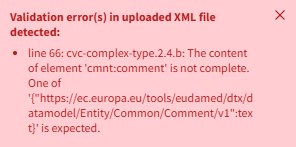
The error message looks similar to the one shown below.
The error occurs because the GET DEVICE XML generated by EUDAMED does not fully comply with the defined XSD format. We are currently investigating how to adapt our system so that XML files of this type can successfully pass XSD validation.
Until the update becomes available, you can either manually remove the affected lines from the XML file or wait for the update to be released.
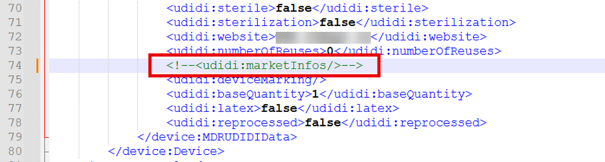
To be able to upload the XML file to swissdamed, we recommend excluding the value (see screenshot). To do so, use the XML comment syntax:
<!-- … -->
This ensures that the corresponding content is ignored during validation and processing.
Note: Using the “Find and Replace” function in an XML editor, you can efficiently apply this change to multiple UDI-DIs at once.
In the meantime, we also recommend opening a ticket directly with EUDAMED to request a resolution of the issue.
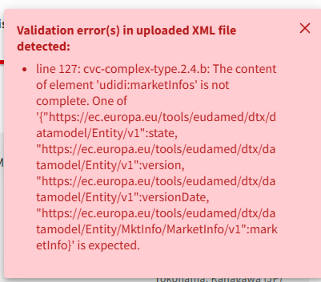
The error message looks similar to the one shown below.
The error occurs because the GET DEVICE XML generated by EUDAMED does not fully comply with the defined XSD format. We are currently investigating how to adapt our system so that XML files of this type can successfully pass XSD validation.
Until the update becomes available, you can either manually remove the affected lines from the XML file or wait for the update to be released.
To be able to upload the XML file to swissdamed, we recommend excluding the value (see screenshot). To do so, use the XML comment syntax:
<!-- … -->
This ensures that the corresponding content is ignored during validation and processing.
Note: Using the “Find and Replace” function in an XML editor, you can efficiently apply this change to multiple UDI-DIs at once.
In the meantime, we also recommend opening a ticket directly with EUDAMED to request a resolution of the issue.
We recommend that companies which are not registered in the swissdamed production system, but are interested in using the playground, contact a company that is already registered. The registered company will be able to set up specific users who only have access to the playground, as described in the following document:
Feedback on new functionalities can be provided within four weeks of each release. Please send your feedback directly to our support team using the contact form on our Support page.
Yes. To ensure correct implementation of the Machine-to-Machine functionality, the onboarding process described in the Machine-to-Machine Rest API documentation must be followed.
Third-party Machine-to-Machine providers needing an account for accessing the playground environment can request this access by opening a ticket on the Swissmedic website under Support.
In the production environment of swissdamed, third-party Machine-to-Machine providers must be onboarded via the respective actors or mandates for whom they are submitting data to swissdamed.
Authentication uses an OAuth2 client credentials flow, as described in the Machine-to-Machine Rest API documentation. Each actor/mandate must obtain a separate client ID and client secret.
The client ID and client secret can be used to obtain an OAuth2-Access token, which is also specific to an actor or mandate. The validity period of a token is indicated when the token is obtained. After expiration, a new token can be obtained using the client ID and client secret.
For mandates, the M2M tab can be found by navigating as follows:
Go to “My actors” > “Registered actors”.
Click on the authorised representative (AR) of the mandate to open the “Actor details” section of the AR.
In the “Actor details” of the AR, open the “Mandate” tab and select your mandate. This opens the “Mandate details” section, where the “M2M” tab is located.
No, the CHRN does not have to be listed in the payload. Each actor or mandate is identified by their specific client ID, client secret, and token. The mfActorCode in the API is intended for providing the EUDAMED SRN, if that is available. When no EUDAMED SRN is available, the value “NA” can be provided instead.
Yes. The API is designed for full dataset submission only, for initial upload as well as later updates of data. swissdamed does not support separate Basic UDI-DI creation or partial UDI-DI updates.
swissdamed does not maintain explicit versions like EUDAMED. Instead, a “Last update date” is shown for Basic UDI-DI, UDI-DI, and Package UDI-DIs individually. POST requests only update data if changes have occurred; resubmitting identical payloads does not update time stamps.
Yes. The playground will remain online and will be available for change management testing. New versions of the M2M API with breaking changes will be rolled out on the playground for testing purposes before deployment to the production environment. Non-breaking API changes will be deployed directly to the production environment.